

Your mind doesn't quiet down just because the day is over.

A different kind of language
You're still right where you've always been.
You just need a way to hear yourself again.
A different kind of language.
Some parts of you don't speak in words. They never did. They live in color, shape, and mark—in what your body knows but your mind can't name.
This is how you hear them. By giving them form.
At the center of this practice is the mandala, a circular structure that holds whatever wants to emerge.
No experience needed. No performance required.
Your body already knows this language.
How you hear yourself again
-

CENTER
Step out of the noise. Twenty minutes. A quiet space to begin.
That’s where it starts. -

CREATE
Color, shape, mark—a different language. Feel what words can't reach. See what takes shape.
-

CONNECT
Carry what you’ve found back into your day—more present, more alive, more you.


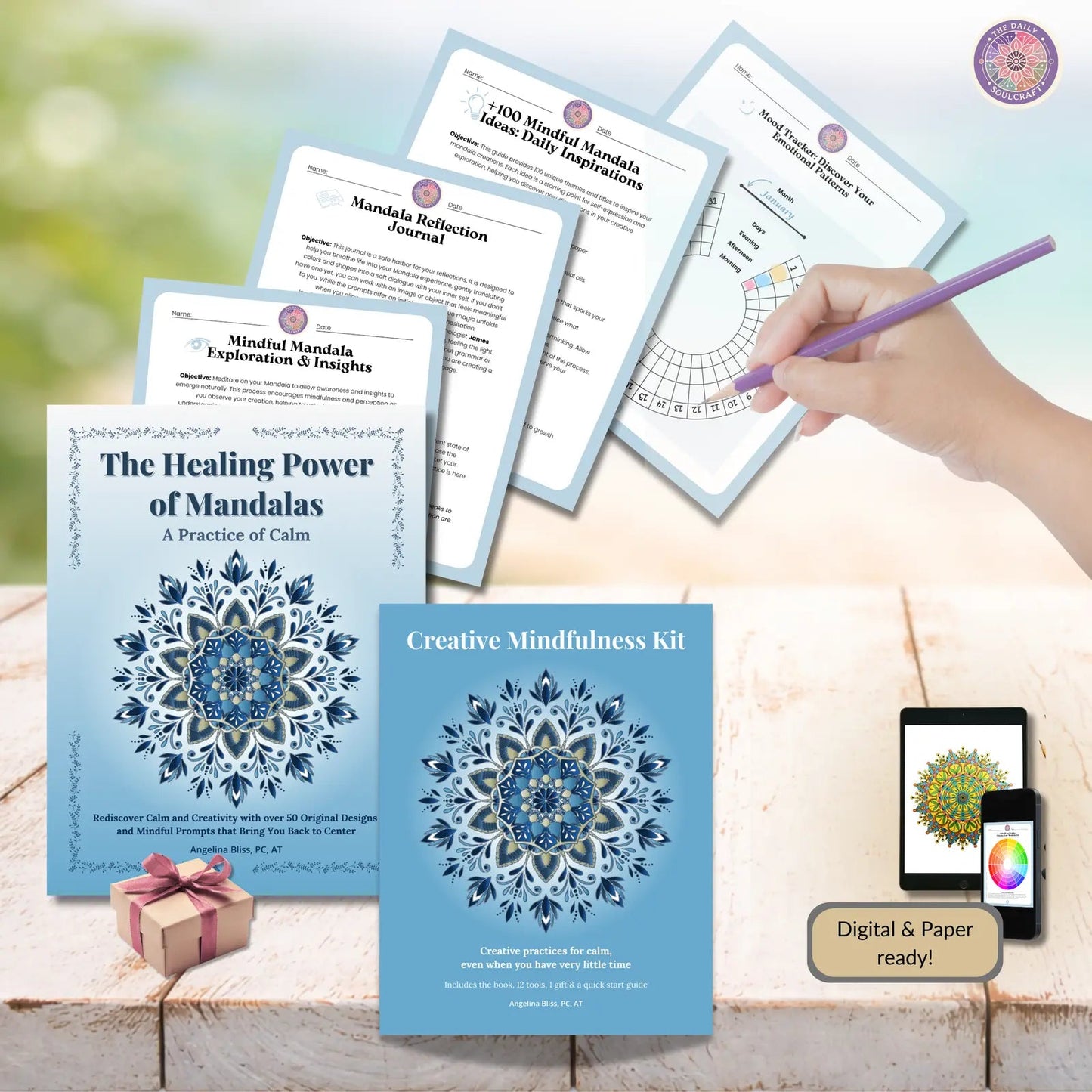
Here’s what you’ll find inside
-

THE FOUNDATION
eBook—The Healing Power of Mandalas
Understand the practice from the inside. 51 original mandalas and guided prompts to move beyond coloring and begin to listen. -

THE TOOLS
12 Creative Mindfulness Tools
Thoughtfully designed tools, where color, music, bodily awareness, and reflection become multiple ways in—all on your own terms. -

YOUR COMPASS
Start Here—The Quick Start Guide
A simple place to begin—without overthinking. See how everything connects, choose your entry point, and let that be enough. -

A SPECIAL GIFT
Try This—30+ Creative Invitations
Over 30 creative invitations—for presence, exploration, play, and connection. Pick one. Return whenever you need.


What happens here
In this space, you can return to yourself—not as an idea, but as a lived experience.
Through reflection, writing, and creative expression, you begin to recognize what is truly yours—your thoughts, your feelings, your own inner ground.
From there, something shifts: you feel more at ease with yourself, more grounded, more real. And from that place, the rest of your day—your choices, your relationships, your voice—begins to move differently.
This is not decorative wellness.
It is rooted in art therapy—in understanding how creative expression reconnects you with parts of yourself that words alone cannot reach.
Distilled into simple, guided ways to begin—again and again.
Created by Angelina Bliss, art therapist and coach, with over 20 years of experience.
From the Studio—Reflections on coming back to yourself
View all-

Mandala Coloring Won't Change Your Life. Here's...
Angelina Bliss | Art Therapist & CoachColoring mandalas can reduce stress—but it’s not what leads to real self-awareness. Discover the difference between mandala coloring and creating your own, and how mindful art can help you reconnect...
Mandala Coloring Won't Change Your Life. Here's...
Angelina Bliss | Art Therapist & CoachColoring mandalas can reduce stress—but it’s not what leads to real self-awareness. Discover the difference between mandala coloring and creating your own, and how mindful art can help you reconnect...
-

When Images Speak What Words Can't: A Visual Jo...
Angelina Bliss | Art Therapist & CoachSometimes an image appears before we understand it. This article explores visual journaling as a way to let color, shape, and intuition reveal what words alone can’t reach.
When Images Speak What Words Can't: A Visual Jo...
Angelina Bliss | Art Therapist & CoachSometimes an image appears before we understand it. This article explores visual journaling as a way to let color, shape, and intuition reveal what words alone can’t reach.
-

The Art of Imperfection: The Healing Journey of...
Angelina Bliss | Art Therapist & CoachWhat if imperfection were not a flaw, but a form of wisdom? A personal story about losing creative expression, finding it again, and what happens in the space between a...
The Art of Imperfection: The Healing Journey of...
Angelina Bliss | Art Therapist & CoachWhat if imperfection were not a flaw, but a form of wisdom? A personal story about losing creative expression, finding it again, and what happens in the space between a...


